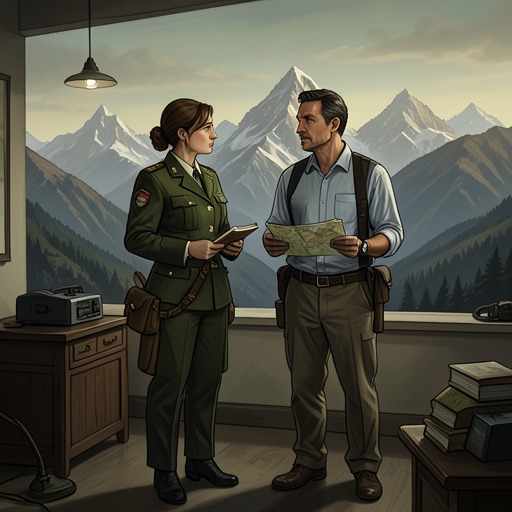
Kristín and Steve’s friendship, shared work, and unresolved past
Operation NapoleonKristín and Steve’s friendship, shared work, and unresolved past is shaped by a separation Kristín regrets, a brief return of hope that they might speak again, and Steve’s murder before her. His death turns an unfinished relationship into a lasting absence: Kristín holds herself responsible, relives the killing, and ultimately treats the knowledge connected to it as something she must pursue rather than leave behind.
Earlier Separation and Renewed Longing
The book gives little detail about the beginning or course of Kristín and Steve’s relationship, but it makes clear that she once ended it. During a later period of exhaustion and disordered thought, she remembers her parents, an ex-boyfriend who was a lawyer, and Steve; she regrets having dropped Steve as she did and thinks that one day she ought to put things right. She would like to see him again and feels a powerful urge to talk to him. The desire is not presented as a settled plan or as evidence of a reconciliation. It is a fleeting but forceful recognition that the relationship remains unresolved, emerging among other thoughts about work, danger, and the possibility of changing her life.
That wish matters because it precedes the loss that makes contact impossible. The narrative offers no account of Steve receiving her regret or answering her wish to meet again. Instead, the prospect of repairing what she had ended is cut off by violence. The relationship’s earlier separation therefore remains unresolved in two senses: Kristín cannot undo the way she left him, and she never gets the chance to address it with him.
Steve’s Death and Kristín’s Account
Kristín recounts Steve’s killing to Miller while hidden in a body bag inside the wreck of the German aircraft. He has told her that he is searching for his brother, giving the two of them a point of connection; he listens patiently as she describes the events that brought her there. By the time she reaches Steve’s death, she is convinced that her own impetuous, selfish pursuit is to blame. She hangs her head in despair after telling the story. Miller believes her and recognizes the ordeal she has endured, but does not dismiss her account as confusion.
Steve had worked at the base. Kristín tells Miller that Ratoff said he would leave her something to remember him by, then shot Steve in front of her. She sees the killing as personal: Ratoff did not need to kill Steve, she says, and did so to torment her. In her account, Steve meant nothing to Ratoff apart from his connection to her. She asks what is happening and whether Ratoff is there; Miller tells her she need not worry about him any longer, but refuses to explain the rest, warning that knowing more will not help her. Kristín rejects that protection. She has come too far to give up, and insists that whether to know is for her to judge.
Grief, Guilt, and the Unfinished Past
The later account of Kristín’s life shows that Steve’s death does not recede with time. She thinks of him every day and relives the killing repeatedly, both while awake and in dreams. The book describes the absence he leaves as a void that will never heal, while also making clear that she would not wish that void away. Her grief is inseparable from guilt: she believes he died because of the knowledge she pursued, and cannot bear the possibility that his life was lost for nothing.
This conviction changes the meaning of her earlier wish to see him. What had been a hope of speaking again becomes an impossible conversation, revisited through memory, and a reason to continue seeking answers. Kristín’s attachment is not shown through a completed reunion or a new shared life; it persists instead through regret, the memory of his death, and the purpose she draws from it. The relationship remains active in her life precisely because it cannot be repaired.
Consequences and Lasting Significance
Kristín’s decision to pursue the matter is not impulsive in its practical execution. A merchant ship’s captain, who had once helped a young Icelandic woman escape her husband with her children, leads her to consider a possible route to Argentina. Kristín does not dare fly through Spain or Italy, fearing surveillance cameras, passenger lists, and passport control. She uses cash where possible, avoids places with closed-circuit cameras, and does not use the internet at home. These precautions belong to her wider flight from surveillance, but her account makes Steve’s death the personal reason she cannot simply regard the affair as finished.
The relationship thus links private loss to the book’s concealed history. Steve’s death is not merely an episode in Kristín’s ordeal: she understands it as a consequence of the secret she uncovered, and continuing to investigate becomes a way of refusing to let his death be meaningless. The past between them remains incompletely told, and their hoped-for conversation never occurs. What survives is Kristín’s regret over having left him, her memory of his final moments, and the unhealed absence that drives her back toward the truth.